There’s a strange emotional trap that catches almost every author at some point: the moment your manuscript is technically finished, “The End” typed, story fully told, it starts to feel automatically ready for the world. It isn’t, not yet, and the gap between “finished writing” and “ready to publish” is exactly where a lot of promising books get published too early and underperform, not because the story or the argument was weak, but because the manuscript simply hadn’t gone through the stages that separate a solid draft from a genuinely publish-ready book.
This isn’t a discouraging thing to hear. It’s actually good news, because manuscript readiness isn’t a mysterious, subjective feeling you either have or don’t. There are real, recognizable signs that separate a manuscript that’s genuinely ready from one that still needs more work before it should go anywhere near a publishing platform.
This guide walks through five honest signs to check your own manuscript against, and what your next move should look like if it’s not quite there yet.
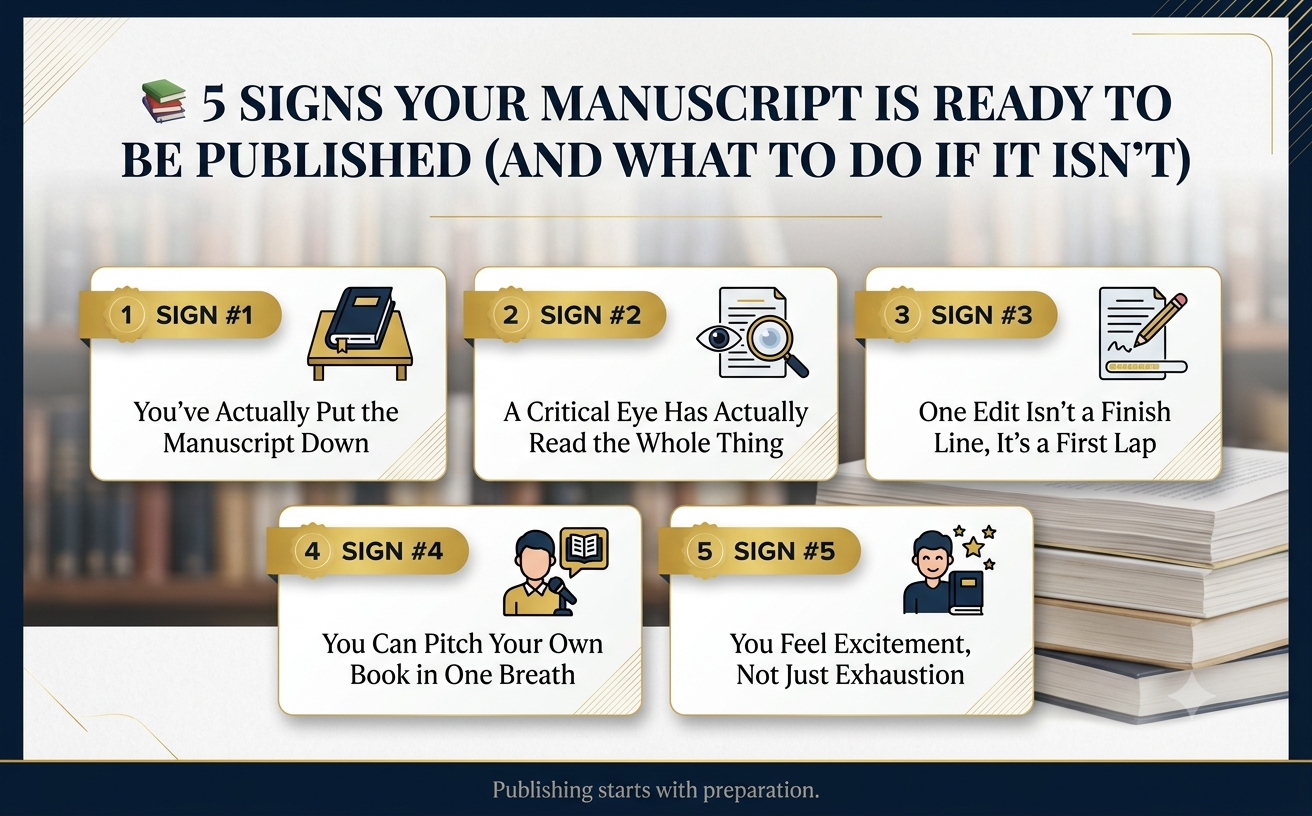
SIGN #1: YOU’VE ACTUALLY PUT THE MANUSCRIPT DOWN
THE “I FINISHED IT YESTERDAY” TRAP
If you finished your last draft yesterday and you’re already thinking about publishing, that’s a signal worth pausing on. Genuine manuscript readiness usually requires stepping away from the work entirely for a period, weeks at minimum, sometimes longer, so you can return to it with something closer to a reader’s perspective rather than a writer’s memory of what you intended each scene to do.
WHAT SKIPPING THIS STEP COSTS YOU
Without that distance, it’s nearly impossible to spot pacing problems, repeated words or phrases, or places where you, as the writer, are filling in gaps mentally that aren’t actually on the page.
Authors who skip this step often discover these issues only after readers point them out, publicly, in reviews.
YOUR MOVE: SET A REAL COOLING-OFF PERIOD
Set the manuscript aside for a defined period before your next read-through. Work on something else in the meantime.
When you come back to it, read it as close to start-to-finish as possible, rather than jumping around, to genuinely feel its pacing and flow the way a reader would.
SIGN #2: A CRITICAL EYE HAS ACTUALLY READ THE WHOLE THING
IT’S NOT READY IF YOU’RE THE ONLY READER
A manuscript that’s only ever been read by its author, no beta readers, no editor, no outside critical eye, is very rarely as ready as it feels from the inside.
Family and friends offering encouragement, while lovely, generally isn’t the same as a critical read focused on identifying weaknesses.
YOUR BLIND SPOTS ARE INVISIBLE TO YOU, BY DEFINITION
Every writer has blind spots specific to their own manuscript. A plot thread that makes perfect sense to you because you know the whole story might genuinely confuse a first-time reader.
Outside eyes, ideally a professional editor, catch structural and clarity issues that are essentially invisible from inside the writing process.
YOUR MOVE: GET AN EDITOR BEFORE ANYTHING ELSE ON THIS LIST
Prioritize getting your manuscript in front of a professional editor before anything else on this list.
This single step tends to surface the most significant readiness gaps, and addressing it properly often resolves several other readiness concerns at once.
SIGN #3: ONE EDIT ISN’T A FINISH LINE, IT’S A FIRST LAP
WHY ONE READ-THROUGH WAS NEVER GOING TO BE ENOUGH
A single read-through, even a critical one, rarely catches everything a manuscript needs. Genuine readiness typically involves multiple distinct passes: a structural or developmental pass focused on the big picture, followed by a line-level pass focused on prose and clarity, followed by a final proofread focused on catching remaining errors.
EACH PASS IS HUNTING FOR SOMETHING DIFFERENT
Each pass is looking for something different, and skipping a stage means those specific issues simply don’t get caught.
A manuscript that’s had a proofread but never a developmental edit might be technically clean, while still having pacing or structural problems that a proofread was never designed to catch.
QUICK READINESS CHECK: EDITING STAGES COMPLETED
| Editing Stage | What It Catches | Have You Done This? |
| Developmental edit | Structure, pacing, plot or argument gaps | ☐ Yes ☐ Not yet |
| Line edits | Sentence-level clarity, voice, flow | ☐ Yes ☐ Not yet |
| Copy edit / proofread | Grammar, spelling, consistency errors | ☐ Yes ☐ Not yet |
If any row is unchecked, that’s a concrete, specific next step, not a vague sense that “something’s not quite right yet.”
SIGN #4: YOU CAN PITCH YOUR OWN BOOK IN ONE BREATH
THE ELEVATOR TEST MOST AUTHORS FAIL
Ready manuscripts tend to come with a clear, confident answer to “what’s this book about, and why would someone want to read it?”
If you find yourself struggling to summarize your own book in a few compelling sentences, that’s often a sign the manuscript itself, or at least your understanding of its core hook, still needs sharpening.
A MUDDLED PITCH USUALLY MEANS A MUDDLED MANUSCRIPT
This isn’t just a marketing exercise; it’s a genuine readiness indicator. A muddled answer to “what’s this book about” often reflects a manuscript where the central premise, argument, or emotional throughline hasn’t fully crystallized yet, even if every individual chapter is well written.
YOUR MOVE: WRITE THE THREE-SENTENCE VERSION FIRST
Try writing a short, honest summary of your book, two or three sentences, no jargon, before you touch cover design or category selection.
If it’s genuinely difficult, that struggle is useful information about where the manuscript itself might still need focus, not just where your pitch needs work.
SIGN #5: YOU FEEL EXCITEMENT, NOT JUST EXHAUSTION
TWO VERY DIFFERENT FEELINGS THAT GET CONFUSED FOR “READY”
There’s a meaningful emotional difference between “I’m excited for readers to experience this book” and “I just want to be done with this process.”
Both feelings are completely understandable after months or years of work, but only one of them reliably indicates genuine readiness.
HOW RELIEF QUIETLY TALKS YOU INTO SKIPPING STEPS
Relief-driven publishing decisions often mean skipping steps, an extra editing pass, more beta readers, a stronger cover, because you simply want the process to be over. That instinct is human, but it’s also exactly how manuscripts end up published before they’re genuinely ready.
YOUR MOVE: GIVE YOURSELF PERMISSION TO SLOW DOWN
Give yourself permission to slow down. There’s no external deadline forcing you to publish on a specific date, and a few additional weeks or months spent getting the manuscript genuinely ready almost always pays off more than rushing to a finish line driven by exhaustion rather than confidence.
“READINESS” FEELINGS THAT ARE ACTUALLY LYING TO YOU
Just as there are genuine signs of readiness, there are a few common signals authors mistake for readiness that don’t actually hold up under scrutiny.
Feeling “sick of looking at it” isn’t the same as it being finished.
Fatigue with a project after months or years of work is completely normal, but it’s an emotional state, not a quality assessment. Plenty of manuscripts get published while their authors are exhausted rather than genuinely confident, and it shows.
Positive feedback from friends and family isn’t the same as critical feedback.
People close to you naturally want to be encouraging, which is valuable emotionally but doesn’t substitute for someone reading with a critical, reader-focused eye.
Having a deadline isn’t the same as being ready.
Self-imposed deadlines, a birthday, a new year, a personal goal, create useful momentum, but they don’t change whether the manuscript itself has actually reached the stages of feedback and editing it needs. A deadline is a scheduling tool, not a readiness indicator.
A polished opening chapter doesn’t guarantee a polished manuscript.
Authors often revise their first chapter more than any other, since it gets the most attention and rereads, which can create a false sense that the whole manuscript is at that same level. It’s worth specifically checking the middle and later chapters with the same scrutiny.
CHECKED EVERY BOX AND STILL NOT SURE? THAT’S NORMAL TOO
Some authors reach genuine readiness on every practical measure, multiple edits complete, outside feedback incorporated, a clear pitch in hand, and still feel a lingering uncertainty.
This is common, and it’s usually less about the manuscript itself and more about the natural vulnerability of putting creative work into the world.
A second, professional opinion at this stage, an experienced editor or publishing consultant reviewing the manuscript specifically for readiness, can be the difference between confidently moving forward and sitting on a genuinely finished book out of hesitation alone.
WHAT COMES NEXT: HOW GULF PUBLISHER CAN HELP
Figuring out whether a manuscript is truly ready shouldn’t rest entirely on gut feeling. At Gulf Publisher, our editorial team works with authors across the UAE, Saudi Arabia, Qatar, Kuwait, Bahrain, Oman, and Iraq to assess manuscripts honestly, identifying exactly what’s genuinely ready and what still needs work, before any publishing decisions are made.
If you’re unsure whether your manuscript has reached that point, reach out for a free manuscript consultation. We’ll give you a clear, honest read on where things stand and what the right next step actually looks like for your specific book.